
AI Literacy
New tools demand new muscles.
Access to AI is not the same as capability with it. Literacy is a shift in skill, mindset and learning culture, and it has to be built deliberately at every level rather than hoped for. This is how we build it, and how we measure whether it worked.
Talk to us All programmesWhat we see in organisations
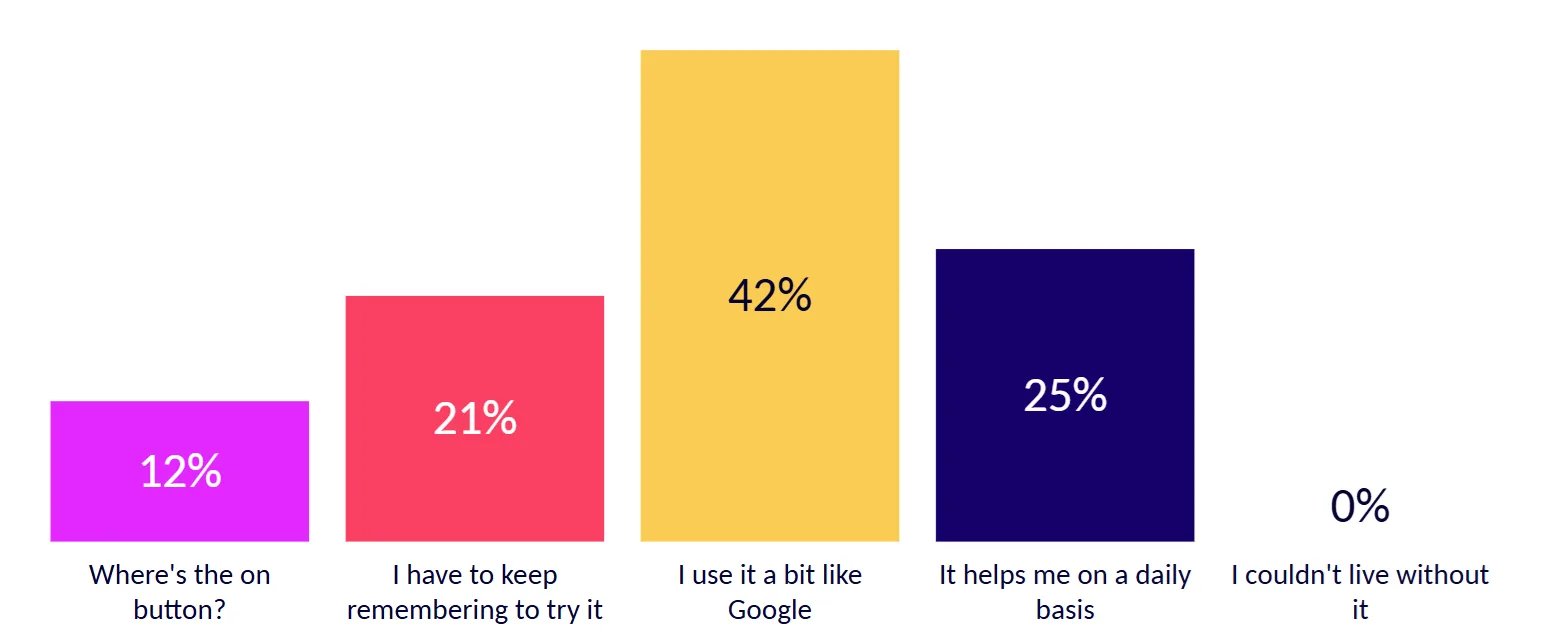
Three quarters of people are still on the left of this chart.
This is the honest distribution across every workshop and immersion programme we ran in 2025. Twelve per cent are still looking for the on button. Forty-two per cent are using AI a bit like Google. Nobody, in any room, said they could not live without it.
That is the gap free tool access does not close. Generic learning rarely lands either: without relevance to the role or the sector, people cannot connect what they learned to what they actually do on a Tuesday.
Why literacy is not a training problem
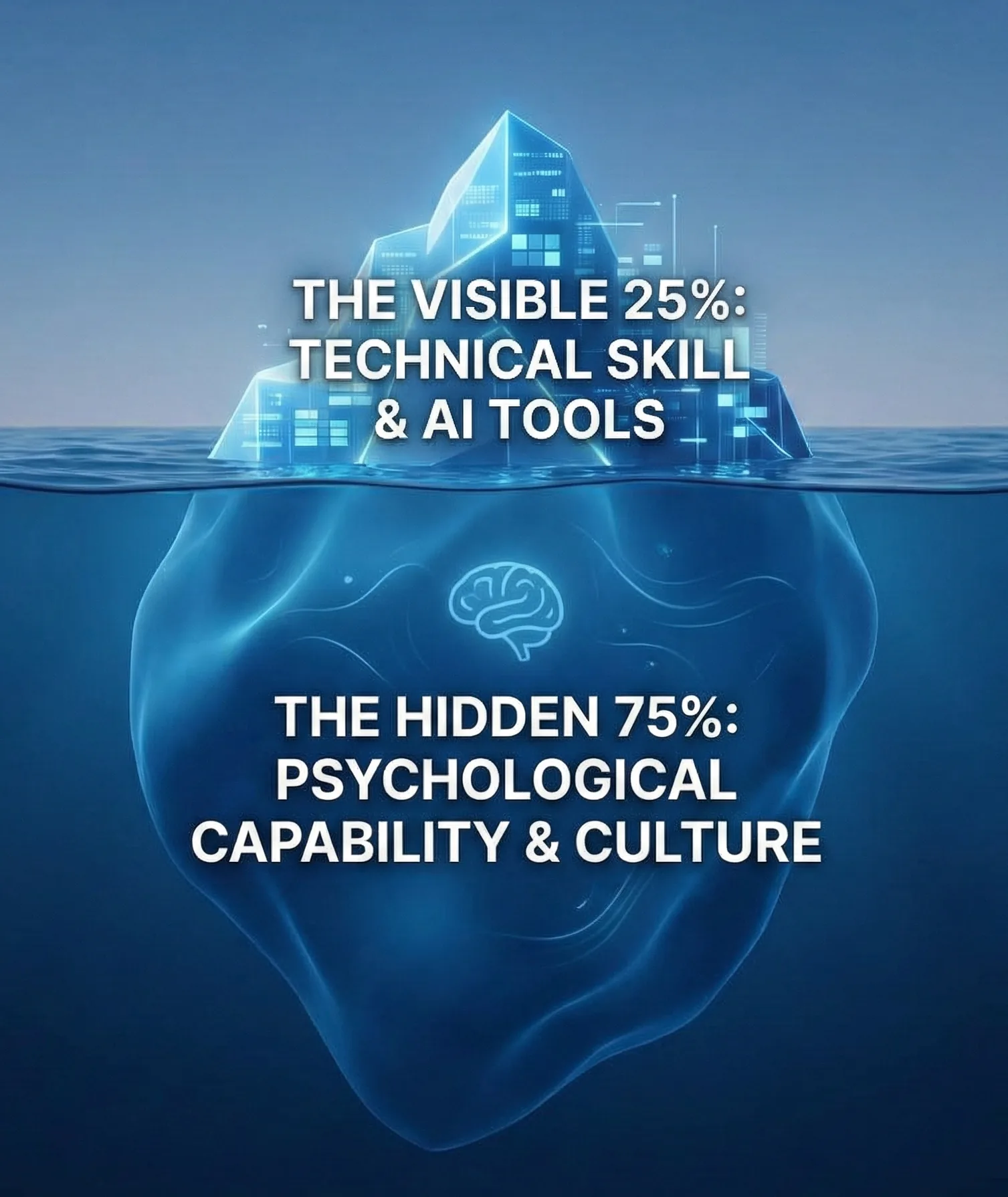
The quarter you can see, and the three quarters you cannot.
Technical skill and tool knowledge sit above the waterline. They are the part that is easy to buy, easy to schedule and easy to measure, which is why most AI programmes stop there.
Underneath sits everything that actually decides whether adoption holds: confidence, psychological safety, whether people believe they are allowed to, whether their manager models it, whether admitting you do not understand something is survivable. We are an organisational psychology practice because that is where the work is.
The BRAIN framework
A way to measure literacy, not just deliver it.
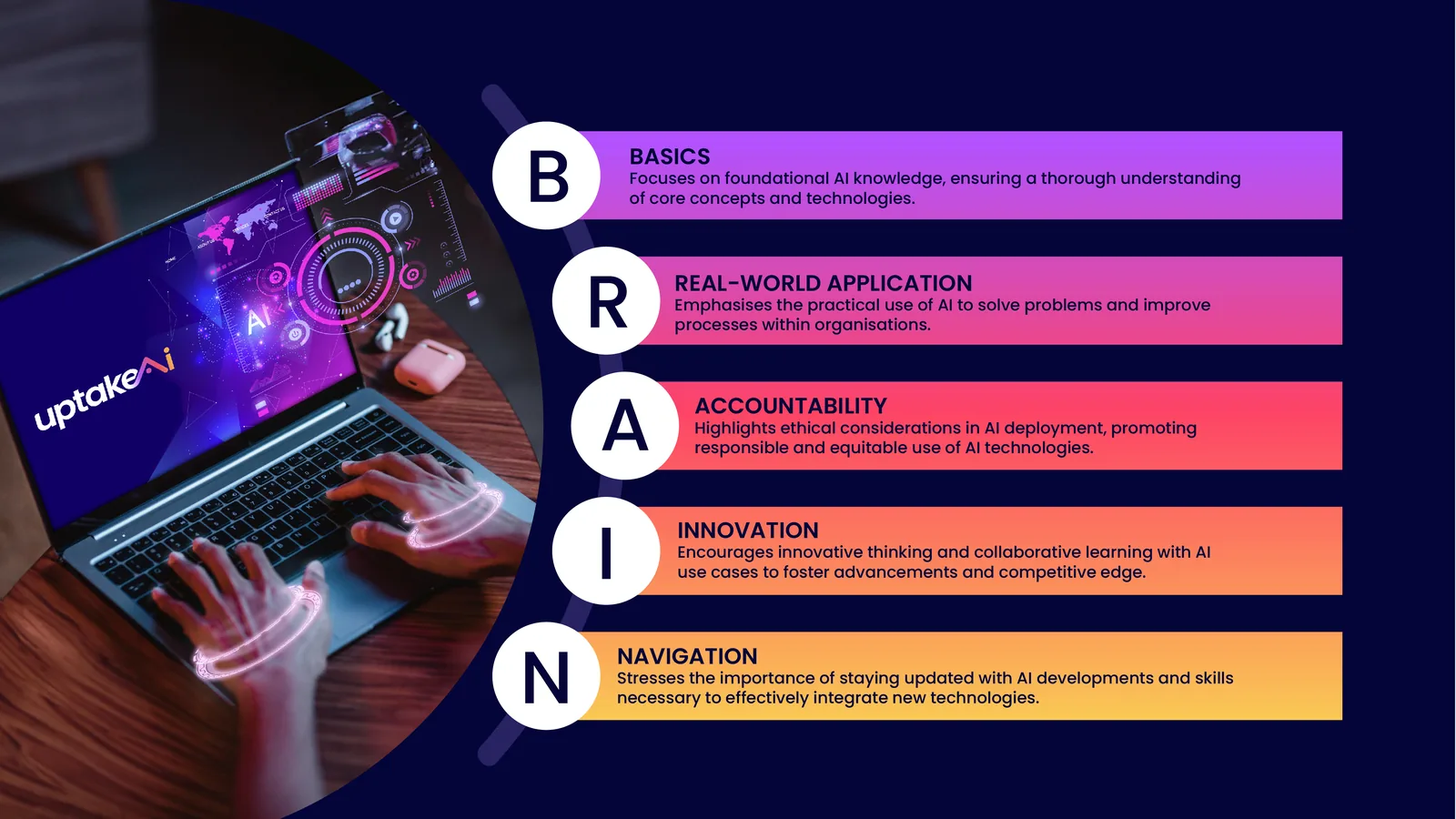
We built the BRAIN Framework© because nothing existing covered all the dimensions an organisation needs to future-proof itself. It defines AI literacy across five, so you can assess where people are, find the gaps and track movement over time.
- Basics: foundational knowledge of AI and large language models
- Real-world application: solving the frictions in your own working day
- Accountability: ethical, transparent and privacy-conscious use
- Innovation: finding the opportunities nobody briefed you to look for
- Navigation: keeping pace with a landscape that will not hold still
The CODER method
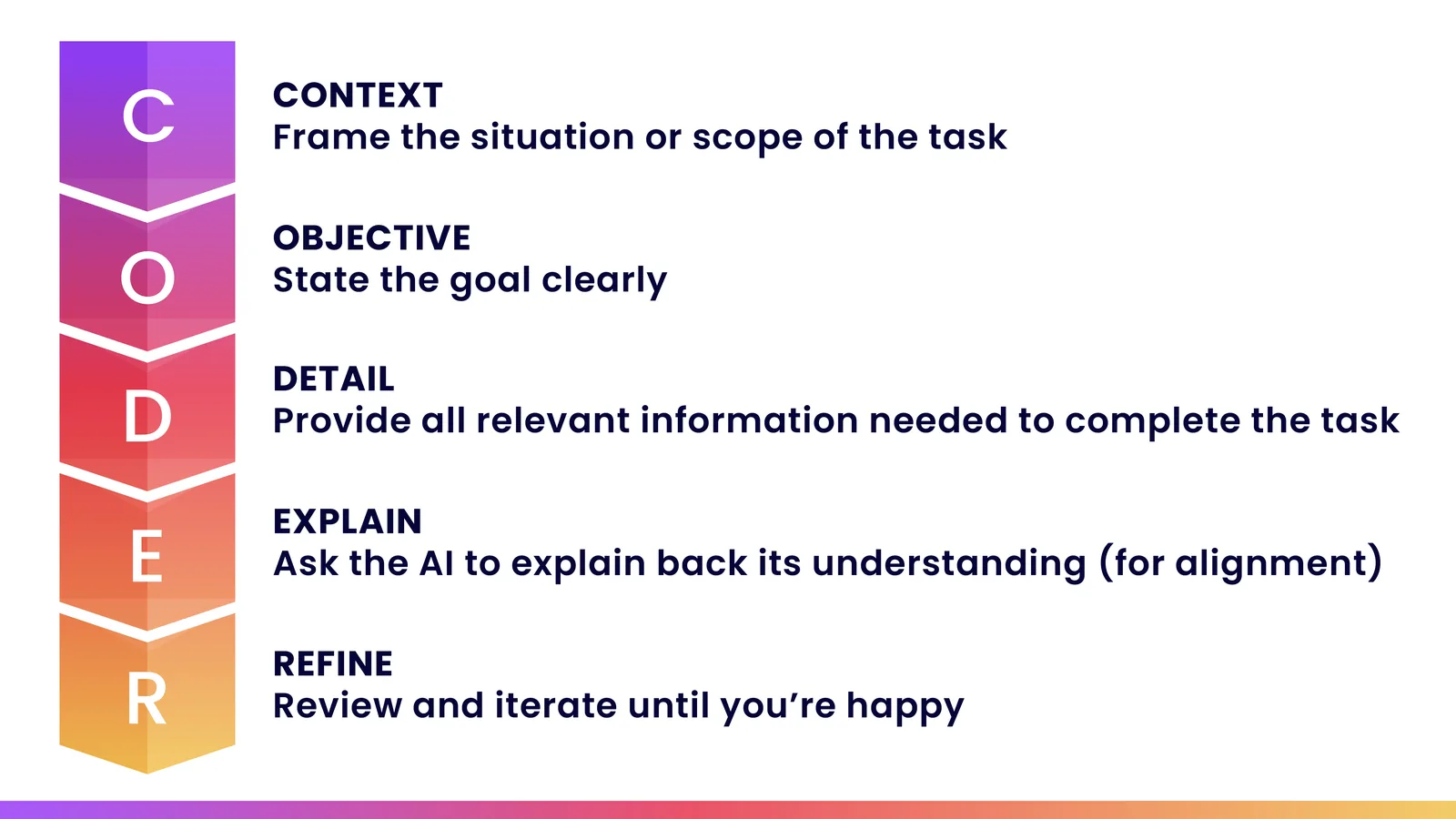
Share the problem. Do not worry about the prompt.
CODER is our prompting framework, and the mantra above is the whole of it. Most disappointing AI output is a briefing failure rather than a tool failure: the person asked for something the way you would type into a search box, not the way you would brief a capable colleague.
CODER gives people a structure for that briefing, which is why it transfers across tools and outlives whichever model is current.
The ladder
Three rungs, depending on where your people are.
Literacy is not one programme. It is a sequence, and the right entry point depends on what the diagnostic finds rather than on what is easiest to book.
Rung one
AI Kickstart
Five weeks, live online, tool-agnostic. Foundational AI literacy for people who need confidence before any platform rollout.
See the programme →Rung two
AI Champions
Eight weeks. Turns a cohort into the people who carry adoption through the rest of the organisation.
See the programme →Rung three
Train the Trainer
Six touchpoints. Your own facilitators, running the learning without us in the room.
See the programme →Rung one
AI Kickstart Programme
A five-week live online programme that builds practical, transferable AI skill quickly. Deliberately tool-agnostic, which is exactly why it works as the thing you run before a Copilot or ChatGPT rollout rather than after one has already stalled.
- Core AI literacy: generative AI, machine learning and language models
- A responsible use mindset, built on a tailored framework not a policy
- Use cases across content, research, data handling and operations
- The CODER prompting method, so delegation is clear rather than hopeful
- The vocabulary and confidence to lead the responsible use conversation

Rung three
AI Facilitators: Train the Trainer
One-off workshops and external experts do not build sustainable capability. Internal facilitators do: people who can guide teams day to day, support behavioural change and help colleagues fold AI into real work. This programme creates them.
- Becoming an AI facilitator: facilitation and adult learning foundations
- AI facilitation in practice: coaching skills and real-time guidance
- Facilitating ethical AI conversations: safe, values-aligned use
- Running peer learning circles: embedding culture and behaviour
- Designing AI skill builders: workshop and micro-learning design
- Leading the AI cultural shift: scaling adoption and sustaining momentum

Common questions
What people ask about AI literacy.
What is AI literacy in a workplace setting?
The ability to use AI tools effectively for research, analysis, automation, learning and content creation, in a way that improves decisions and how work actually gets done. It is a mix of knowledge, confidence and judgement rather than technical skill on its own.
Where should we start, Kickstart or Champions?
Kickstart if people are not yet using AI with confidence. Champions if capability is reasonable but nothing is spreading beyond the enthusiasts. A PRISM read answers it properly before you commit a cohort.
Is the training tied to a specific tool?
No. Kickstart is deliberately tool-agnostic, which is why it works well ahead of a Copilot or ChatGPT rollout. If you need the platform-specific version, that is Copilot Champions.
How do you measure AI literacy?
Through the BRAIN framework, across its five dimensions. It gives a baseline, a gap analysis and a way to track movement, rather than a single score that flatters everyone.
Does this reach people a workshop cannot?
Facilitated programmes change the people in the room. For everyone else, e-Learning delivers scenario-based learning into your own LMS.
Build the capability properly.
Or start with a PRISM read, so the training lands where the gap actually is.
Talk to us Start with PRISM