Articles · 1 June 2026 · Lucy Pitt
You Have Until August
The EU AI Act's August 2026 deadline requires UK organisations to demonstrate AI capability. This article explains what Article 4 actually requires, why generic training falls short, and what auditors look for.
The EU AI Act does not apply automatically to all UK organisations. But it does have extraterritorial reach: if your AI systems are placed on the EU market, or if their outputs affect people in the EU, the Act applies regardless of where your business is based. For many UK organisations, that is not a theoretical risk. It is a current one.
The date that has moved from background noise to live pressure is 2 August 2026. That is when compliance expectations for a significant tranche of AI systems stop being aspirational and start being auditable.
The question landing on desks in June looks something like this: we have the tools, we have briefed the team, we may have run an awareness session. Is that enough to demonstrate AI capability?
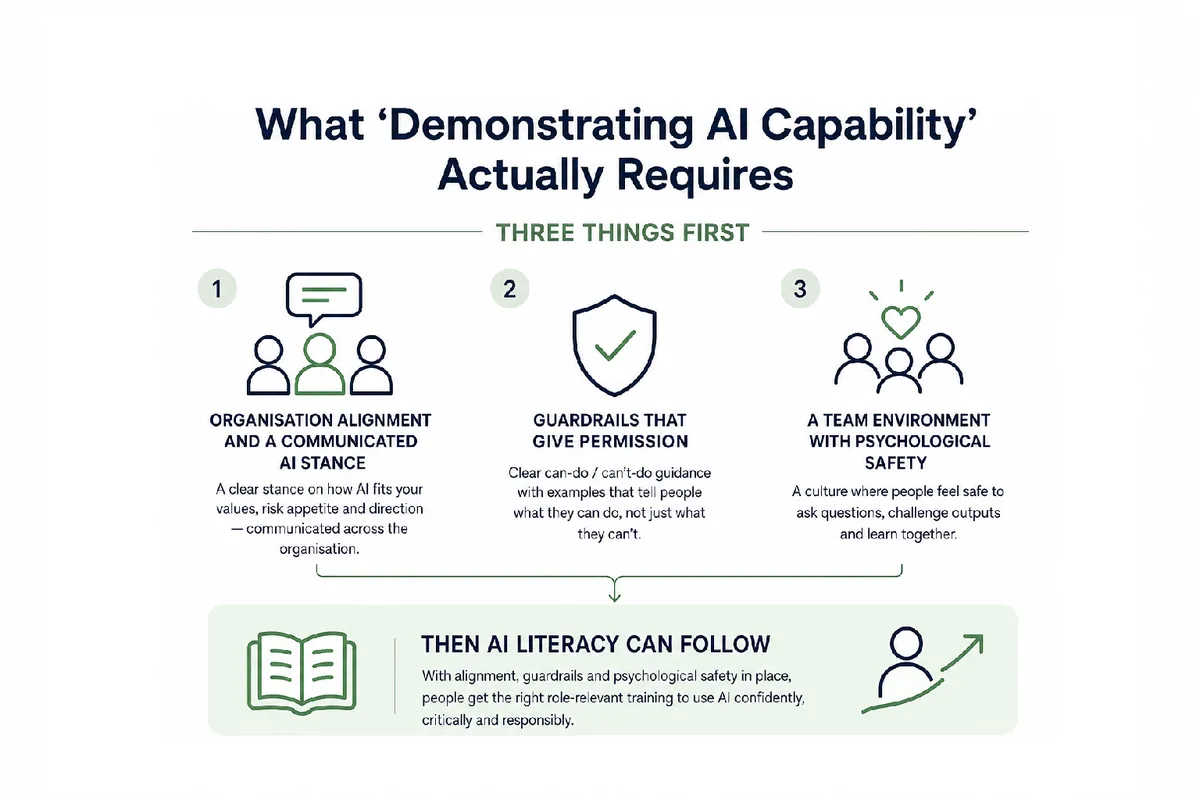
In most cases, no. But the fix is more straightforward than most organisations expect. It requires three things, in sequence, before AI literacy can follow.
THREE THINGS FIRST
The instinct when a compliance deadline arrives is to reach for training. Book a workshop, deploy a module, tick a box. But information is not the bottleneck.
We have been watching AI adoption closely across housing, professional services, and manufacturing. What we consistently see is that staff largely know AI will change how they work. Many are already using it at home. The gap is not awareness. It is structure. And structure has to come first.
Organisation alignment and a communicated AI stance. Guardrails that give permission. A team environment with psychological safety. Then AI literacy follows.
Each of these is load-bearing. Skip one and the literacy work sits on sand.
1. ORGANISATION ALIGNMENT AND A COMMUNICATED AI STANCE
Before any training lands well, an organisation needs to have decided what it actually thinks about AI and communicated that clearly. Not a policy document buried in the intranet. A stance: how we see AI in this organisation, where it fits our values and our risk appetite, and what our direction of travel is.
This matters for two reasons. First, people will not engage seriously with AI capability building until they trust that the organisation has a coherent position. If the leadership message is ambiguous, the floor response is either anxious avoidance or ungoverned experimentation, and often both simultaneously in different parts of the team.
Second, regulators and auditors are looking for exactly this. A documented organisational AI stance, clearly communicated and linked to governance decisions, is one of the earliest signals of genuine capability. It is also one of the most commonly missing.
2. GUARDRAILS THAT GIVE PERMISSION
The word guardrails tends to land as restriction. It should land as permission. A clear set of guardrails tells people what they can do, not just what they cannot, and that reframe matters enormously in practice.
Effective guardrails are specific. Not 'use AI responsibly' but a clear can-do / can't-do framework with worked examples of both. What does responsible AI use look like in this role, with these clients, in this context? What kinds of decisions should always have a human reviewing the output? What are the low-risk use cases where experimentation is actively encouraged?
When guardrails are specific and permission-oriented, they change behaviour in the room in a way that a general policy document does not. People know where they stand. They know what is expected. They can act without anxiety about whether they are doing it wrong.
This is also what auditors want to see. Not a prohibition list, but evidence that your organisation has thought through the range of AI use cases relevant to its work, mapped the risk level of each, and given staff clear, practical guidance for both.
3. A TEAM ENVIRONMENT WITH PSYCHOLOGICAL SAFETY
The third element is the one most commonly treated as a nice-to-have. It is not. Psychological safety, specifically the safety to challenge AI outputs, admit uncertainty, and ask questions without feeling exposed, is the variable that consistently predicts whether AI capability gets embedded or stays superficial.
When people feel safe to say 'I'm not sure this output is right' or 'I don't understand what this tool is doing', they engage critically with AI. They develop judgment. They build the habit of treating AI as a first draft that requires their review, not a final answer that requires their signature.
When they do not feel safe, they perform compliance. They pass the awareness quiz and accept AI outputs uncritically when no one is watching. The knowledge is present. The habit is not.
A team environment that supports learning is not a cultural aspiration. It is a governance requirement. The AI Act's human oversight provisions depend on people actually exercising oversight, which means they need to feel confident and supported in doing so. Without that environment, the governance framework is decorative.
THEN AI LITERACY CAN FOLLOW
With alignment, guardrails, and psychological safety in place, AI literacy lands differently. People engage not because they have been told to but because they have a clear context for what they are learning, permission to experiment, and an environment where questions are welcomed.
Article 4 of the Act makes a second requirement explicit: training must account for the context and tasks each person's role involves. A salesperson and a finance lead need different things. Generic e-learning that treats every employee the same does not satisfy this, and auditors are increasingly equipped to spot the difference.
Role-relevant literacy means your salespeople understand how to use AI in client-facing conversations, where the risks sit, and what the can-do / can't-do looks like for their specific context. Your finance team understands how AI affects their oversight obligations. Your people managers understand what AI-assisted performance decisions require in terms of human review. The training is designed around the work, not the tool.
The training sticks. The capability builds. The organisation can demonstrate not just that training happened but that it changed how people work. That is the difference between a compliance certificate and genuine AI capability.
AN EIGHT-WEEK PRIORITY FRAME
If you are reading this in June and the honest position is that none of these three foundations are fully in place, eight weeks is workable. It requires focus.
Start with the stance. Get alignment at leadership level on what your organisation's AI position actually is. Write it plainly, not in legal language. Communicate it to the team before you ask them to engage with any training.
Build the guardrails around your highest-risk use cases first. Where are people using AI in ways that affect individual outcomes: recruitment, performance assessment, client-facing communications, housing allocations, financial decisions? Define the can-do / can't-do for those use cases specifically, with examples.
Name an accountability structure. Who is specifically responsible for AI governance decisions in your organisation? If the answer is no one specifically, that needs to change before August. Name the people. Define the escalation route. Document it.
Then design your training to be role-relevant, not generic. Article 4 requires it. More importantly, it is the only version that actually works.
THE OPPORTUNITY INSIDE THE PRESSURE
Compliance deadlines are uncomfortable yes, but they are also clarifying.
The organisations that use August as the forcing function for getting the foundations right come out of it with something more durable than a compliance certificate. They come out with a team that knows where it stands on AI, knows what it can and cannot do, and has built enough psychological safety to keep developing that capability as the technology evolves.
That is not a training outcome. It is an organisational capability. And it is what 'demonstrating AI capability' actually means.
uptakeAI helps organisations build genuine AI capability through structured programmes covering leadership alignment, governance design, and role-relevant learning. If you are working toward an August deadline, get in touch: info@uptakeai.co.uk
Where does your organisation actually sit?
PRISM answers with evidence rather than opinion.
Explore PRISM