Articles · 1 April 2026 · Lucy Pitt
WHY AI TRAINING PROGRAMMES FAIL IN MONTH TWO
Six months after rolling out an AI tool, most organisations find only 15% of their people are still using it. This is the month-two problem. We explain why AI training programmes fail after the initial enthusiasm fades, and what organisations need to do differently to make adoption stick.
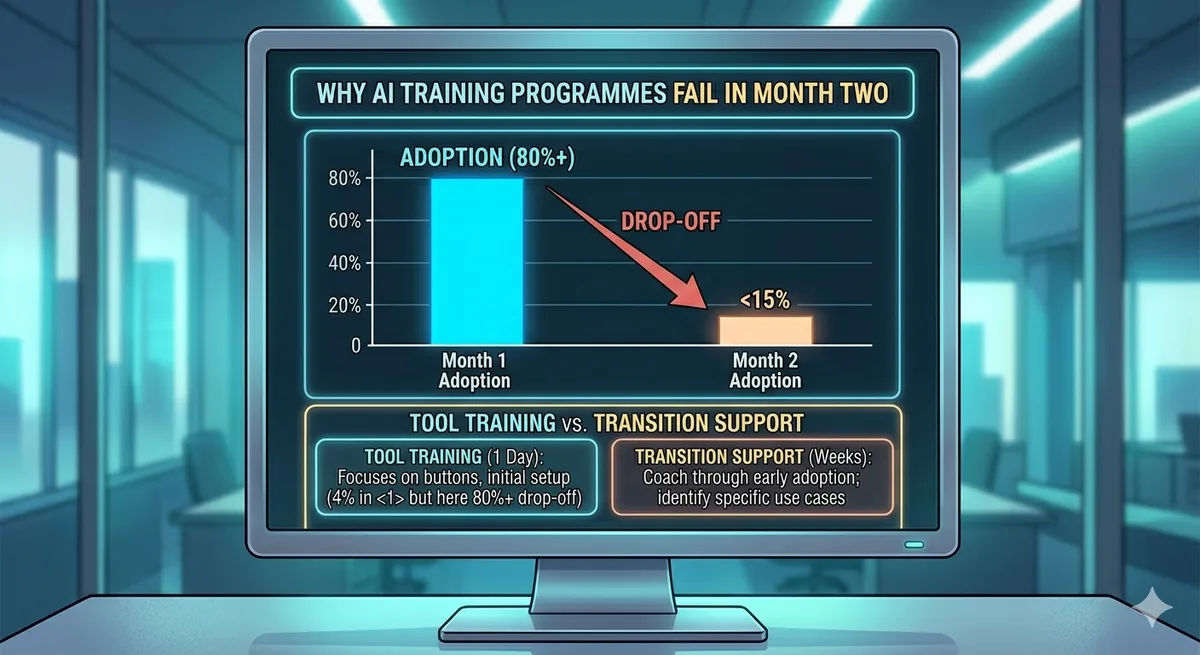
Six months after an AI tool goes live, most organisations quietly discover the same uncomfortable truth: only around 15% of their people are still using it.
The rollout looked like a success. A vendor came in, ran a two-day training session, everyone got their login credentials, and a few early adopters started showing off what the tool could do. Leadership was pleased. The team seemed engaged. Tick.
Then month two arrived.
What Happens in Month One
Month one is easy to mistake for momentum. People are curious. The tool is new. There is novelty value in experimenting with something different, and most staff will give it a genuine go when it has just been introduced.
Training sessions are attended. Usage figures look reasonable. Some individuals find genuine utility straight away and become visible advocates. Managers point to these people as proof the programme is working.
But month one success is almost entirely driven by novelty and obligation. It does not tell you whether the tool has actually been embedded into the way people work. That answer comes later.
The Month Two Drop-Off
Research from HBR suggests that 83% of enterprise software implementations fail to achieve their adoption targets. The failure does not usually happen at launch. It happens quietly, six to eight weeks in, when the novelty fades and the real test begins.
By month two, the initial training is a distant memory. The person who ran the sessions has moved on to the next rollout. Staff are back in the flow of their actual jobs, under real deadlines, using the tools and habits that have always worked for them.
The AI tool sits in a browser tab or an app menu, unused.
This is the month-two problem. And it is not caused by bad technology.
Three Factors That Drive Failure
1. Training that ends at the tool
Most AI training programmes are designed around the product, not the person. Attendees learn what buttons to press. They do not learn how to restructure their own workflows to make space for the tool, how to judge when AI output is good enough, or how to build the habit of using it under pressure.
2. No change in working context
If nothing changes around the tool, people revert to existing behaviour. Old habits are efficient and low-risk. A new tool, even a good one, requires cognitive effort to adopt. Without changes to processes, expectations, or workflows, the path of least resistance is always to keep doing what you were doing before.
3. Social proof dries up
In month one, there are visible examples of people using the tool and talking about it. By month two, those conversations have moved on. If the organisation is not actively creating new examples, sharing wins, and normalising use, the psychological pressure to adopt disappears.
Tool Training Is Not the Same as Transition Support
There is a meaningful difference between teaching someone how to use a tool and helping them transition to a new way of working.
Tool training takes a day. Transition support takes weeks. It involves coaching people through the awkward early period when the tool feels slower than their existing approach. It involves helping teams identify specific use cases that fit their actual roles. It involves leadership visibly modelling new behaviours, not just endorsing them in an all-hands presentation.
Organisations that invest only in the former and skip the latter consistently end up with strong month-one numbers and poor long-term adoption.
What to Look For in an AI Adoption Programme
When evaluating whether an AI training programme is likely to work, ask three questions:
Does it address the transition, not just the tool? Good programmes include support during the six to eight weeks after launch, not just at the point of introduction.
Does it connect to real workflows? Generic training rarely sticks. Effective programmes map AI capabilities to the specific tasks and responsibilities of each team, so staff can see immediate, relevant applications.
Does it build habits, not just awareness? Awareness fades. Habit formation requires repetition, reinforcement, and feedback over time. Look for programmes that include structured follow-up, peer learning, and practical accountability.
The Organisations That Get This Right
The ones that beat the month-two drop-off treat AI adoption as a change management challenge, not a training event. They invest in the weeks that come after launch, not just the day itself. They measure adoption at 60 and 90 days, not just at day one. And they build internal capability so that adoption is sustained without ongoing external support.
If your last AI rollout looked promising in week one and quiet by week eight, you are not alone. But the solution is available, and it does not require better technology.
Interested in building an AI adoption programme that holds past month two? Talk to us.
Where does your organisation actually sit?
PRISM answers with evidence rather than opinion.
Explore PRISM