Articles · 15 April 2025 · Lucy Pitt
What My Dissertation on the Death of the Travel Agent Can Teach Us
25 years ago, I wrote a dissertation titled “Using the World Wide Web to Compete in Tomorrow’s Tourism Marketplace.” At the time, that sounded very Tomorrow’s World and I remember thinking at first it
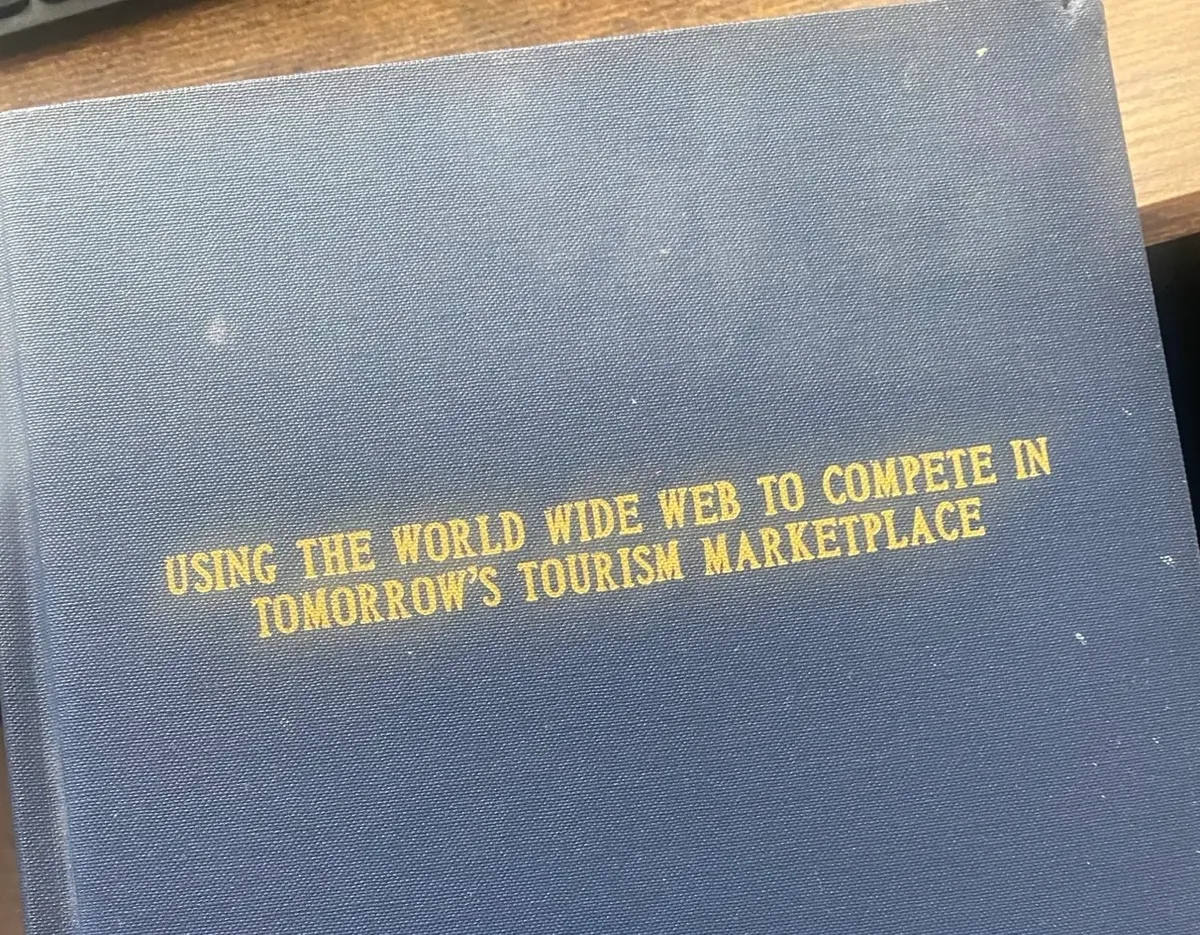
25 years ago, I wrote a dissertation titled “Using the World Wide Web to Compete in Tomorrow’s Tourism Marketplace.” At the time, that sounded very Tomorrow’s World and I remember thinking at first it wouldn’t be as bigger a deal LOL. But what I was exploring was whether this strange new thing called “the Internet” (which many businesses were deeply suspicious of) might just change the way we book holidays.
Spoiler: it did.
What’s hilarious, looking back, is how seriously we debated whether email would take off, or whether high street travel agents would “go the way of the dodo.” (Actual quote. From someone called Brenda from Uckfield in my research.) We were quite literally working in the digital dark ages. No internet in most homes, e-commerce capabilities in just 13% of the businesses I interviewed, and people thinking it was revolutionary to get confirmation of a booking by email.
And yet, here we are again. 25 years later, facing a different kind of disruption. This time, it’s AI.
Déjà vu, but make it digital
In 1999, following this research I found myself explaining to tourism businesses why the “World Wide Web” wasn’t just a passing phase. Some had websites. Many didn’t. Most had never made an online sale. A large number didn’t even want to. Aged workforces, lack of office space (to fit a computer!), customers want to speak to a person, and a general belief that “our customers don’t use the internet” were all seen as valid reasons to avoid it entirely.
Fast forward to today, and I’m hearing the same things when it comes to AI.
“We’re too small.”
“It’s just hype.”
“Our customers want the human touch.”
Sound familiar?
In 1999 into 2000, it was online bookings threatening the high street. Now, it’s ChatGPT writing proposals, Copilot automating tasks, and generative AI quietly getting better at everything from sales forecasting to content creation. Once again, there’s panic. Once again, there’s promise.
The death of the travel agent… or the evolution of one?
Back then, I quoted a travel agent who said:
“What chance do we stand against these online wizards?”
There was genuine fear. Of being replaced. Of not being technical enough. Of not being needed anymore.
And in many ways, they were right - at least the ones who didn’tadapt. Online intermediaries surged, price comparison engines boomed, and Ryanair announced they’d made 50% of seat-sale bookings online (which felt like science fiction at the time). But others did survive. Not by competing with Google, but by doubling down on what humans do best: personal relationships, complex itineraries and curated experiences.
AI will have the same effect. The question isn’t ifAI will change your business, it’s how you respond when it does.
What yesterday's internet teaches us about today’s AI
Reflecting on my slightly yellowing pages, I see clear parallels between then and now. So here are five things I believe hold true for both the dawn of the internet and the rise of AI:
- Adoption doesn’t wait for comfort. Businesses that waited for “the right time” to go online were often left behind. AI won’t wait either.
- The first movers weren’t always the biggest. Small, agile businesses often moved faster than large incumbents. Don’t underestimate what you can do with a few good tools and the right mindset.
- Customer behaviour is the real disruptor. People eventually chose online bookings. They’ll choose AI-assisted service too, if it saves them time, money, or stress.
- It’s not about the tech. It’s about the use case. Back then, it was about convenience and price. Now, it’s about speed, personalisation, and freeing up humans to do more meaningful work.
- Fear is normal…but not a strategy. Back then, the fear was job loss. Today, it’s the same. But roles didn’t disappear, they evolved. New ones emerged. And they will again.
From travel agents to AI agents: A mindset shift
One of the most quoted lines in my dissertation (by me, anyway) was:
“The Internet is here today and anyone waiting for tomorrow to come is waiting for death to settle.” Someone called Chaplin, 1999
Pretty dramatic. But it turned out to be right. The same sentiment applies to AI.
We don’t need everyone to become machine learning experts. But we do need leaders, teams, and organisations to be curious. To experiment. To fail a bit, learn fast, and stop waiting for the “final version” of AI to arrive tied up in a corporate PowerPoint with a bow on it.
This is happening now. Just like the early web, it’s messy, imperfect, unregulated, and… unstoppable.
What’s your AI Ryanair moment?
In the travel world, the tipping point came when big players like Ryanair, British Airways, and Preview Travel embraced the web publicly and loudly. That gave others permission to follow.
So ask yourself:
- What does your AI tipping point look like?
- What processes could you automate?
- What customer journey could you improve?
- What task could you make faster, smarter, or more human by removing the admin?
- How will you embrace AI publicly and loudly?
Final boarding call
Looking back on my dissertation 25 years later is slightly surreal (and bloody scary how time flies!). It’s humbling, hilarious, and a little spooky how history repeats itself, only now the bandwidth is faster.
But it’s also heartening. Because it reminds me that disruption doesn’t mean destruction, it means reinvention.
So if you’re a business leader, a consultant, or just someone wondering how on earth to keep up in the AI era, remember this: You’ve done this before. We all have. This time, we’re just swapping dial-up tones for prompts.
Let’s get curious, not fearful. Because if history’s taught us anything, it’s that the ones who leaned in (not held back) were the ones who thrived.
Lucy Elizabeth Pitt (BA Hons) 2000.
(Still laughing about how digital TV was meant to beat the Internet.)
The possibilities with AI are endless - here's just a few to kick start
your thinking...
Content Creation: Assists in generating content for blogs, websites, and marketing, particularly useful for content marketers and copywriters. Also helpful in HR for creating job summaries and interview questions.
Where does your organisation actually sit?
PRISM answers with evidence rather than opinion.
Explore PRISM