Articles · 15 April 2026 · Lucy Pitt
What an AI Governance Audit Actually Reveals
Most organisations assume they know how AI is being used internally. An AI governance audit typically reveals something more uncomfortable. This article covers what you actually find, and what to do about it.
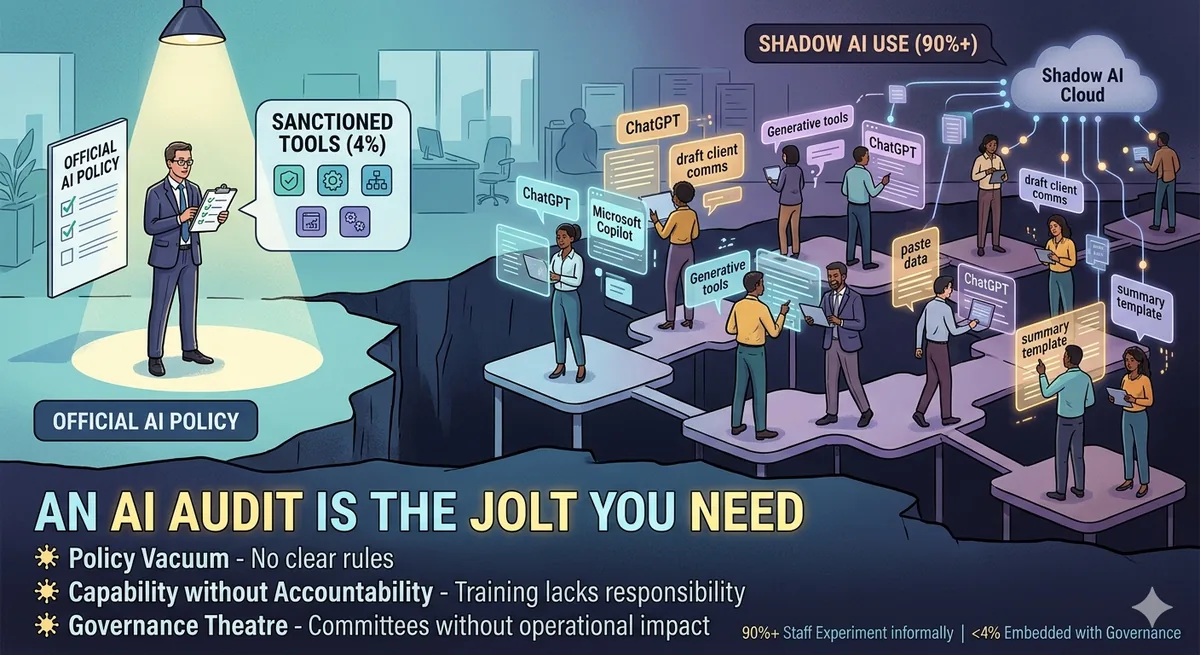
Most senior leaders assume they have a reasonable picture of how AI is being used in their organisation. Most are wrong.
Not because they are not paying attention. But because shadow AI does not announce itself. It lives in the gap between what staff are officially permitted to do and what they are quietly doing to get their jobs done. When you run a proper AI governance audit, the results tend to land with a jolt.
Here is what that actually looks like in practice...
The Shadow AI Problem Is Larger Than You Think
In a typical mid-sized organisation, by the time leadership starts to formalise its approach to AI, a significant number of staff are already using it. Not in a coordinated, sanctioned way. In the way that happens when people discover something genuinely useful and start using it before anyone has had time to write a policy.
Research across UK organisations consistently shows that over 90% have employees who have experimented with generative tools such as ChatGPT or Microsoft Copilot. Fewer than 4% have embedded them at scale with governance structures in place. That gap, between informal use and formal governance, is where risk concentrates.
An audit surfaces this quickly. When you ask employees honestly, and create the psychological safety for them to answer honestly, you find ChatGPT being used to draft client communications without any review. You find sensitive data pasted into public-facing AI tools. You find staff who have been using the same AI-generated summary template for months, with no one checking the underlying assumptions or accuracy.
None of this is malicious. It is entirely human. People use tools that help them. The problem is that without governance, the organisation has no visibility, no accountability, and no ability to course-correct when something goes wrong.
The Three Gaps an Audit Typically Reveals
Across the organisations we have worked with, AI governance audits consistently surface three structural gaps.
The first is the policy vacuum. Most organisations have updated or created data protection policies in recent years, but few have extended those policies specifically to AI use. There is often no guidance on which tools are approved, what data can and cannot be fed into them, or who is responsible for reviewing AI-generated outputs before they reach clients or the public. Staff are making these calls individually, with no shared standard and no clear floor of what good looks like.
The second gap is capability without accountability. Training, where it has happened at all, has tended to focus on how to use AI tools rather than on the harder questions: when to use them, when not to, and who carries responsibility when the output is wrong. Competence and accountability are two different things. An audit almost always finds people who feel confident using AI but have no clear answer to the question of who they would escalate to if something went wrong.
The third gap is governance theatre. Some organisations have committees, policies, or roles with 'AI' in the title that, on closer inspection, have not yet translated into operational change. A working group that meets quarterly but has no mandate to block or modify live AI deployments is not governance. It is governance-shaped activity. The audit helps distinguish between the two, and that distinction matters enormously when you are trying to explain your AI risk posture to a regulator or a board.
Why the Urgency Is Real
The case for moving now is not primarily theoretical. The EU AI Act came into force in 2024 and has been progressively applying obligations to UK organisations with European operations. Domestic UK AI regulation is also developing, with sector-specific guidance from regulators including the Financial Conduct Authority, the Information Commissioner's Office, and the Housing Ombudsman, all of which reference AI governance as an area of growing scrutiny.
Beyond regulatory risk, there is the operational exposure that comes with AI becoming genuinely load-bearing inside organisations. When staff are relying on AI-generated outputs to make decisions about clients, budgets, or services, the consequences of a governance failure are no longer abstract. They are reputational, financial, and in some sectors, directly relevant to safeguarding and duty of care.
The organisations that move earliest on governance are also building something valuable for the future. They are creating the conditions in which staff can use AI with confidence, escalate concerns without fear, and adopt new tools quickly because the framework for doing so already exists. That is a structural advantage, and it compounds over time.
What Good Governance Actually Looks Like
An AI governance framework does not need to be complex to be effective. The organisations that make the most progress are those that focus on three practical foundations rather than attempting to create a comprehensive policy architecture overnight.
The first is a clear inventory of AI use. Before you can govern something, you need to know what is being used, by whom, and for what purpose. A straightforward anonymous use survey, combined with a review of the tools your organisation has licensed and the shadow tools staff are accessing independently, gives you the baseline. You may be surprised by what you find.
The second is a decision framework, not a long list of rules but a short set of questions that any employee can apply before using AI in a consequential context. What data am I sharing? What will the output be used for? Has this been reviewed by a person? Who is accountable if this is wrong? When these questions become habitual, governance becomes embedded rather than policed.
The third is psychological safety. Governance that relies on people never making mistakes with AI is governance that will fail. The organisations that manage AI risk well are the ones where staff feel able to admit when they have made an error, or when they are unsure whether what they are doing is appropriate. That requires intentional cultural work. It cannot be achieved through policy alone.
Where to Start
If you do not know with confidence how AI is being used in your organisation today, the most useful next step is simply to find out. Not through a compliance exercise, but through an honest conversation with the people doing the work.
An AI governance audit does not have to be a months-long project. A structured set of interviews, a brief use survey, and a review of current policy coverage can give you enough to act on within a matter of weeks. What it will give you, almost certainly, is a clearer and more uncomfortable picture than the one you currently have.
The good news is that this is fixable. Organisations that are early in their governance journey are not behind. They are at exactly the right moment to build something that holds. The ones that wait until a governance failure forces the conversation will find the process considerably harder.
The technology is not going to slow down to let organisations catch up. But governance, done well, does not have to slow the technology down either. It creates the conditions for faster, safer adoption. That is the argument for moving now.
Where does your organisation actually sit?
PRISM answers with evidence rather than opinion.
Explore PRISM