Articles · 19 August 2026 · Lucy Pitt
The Frozen Middle Is Not Resistance
What an AI readiness census says about why adoption stalls at the manager layer
Thirty-six percent.
That is how many middle managers in a recent organisation-wide AI readiness census were using AI less than once a week.
In the same organisation, every senior leader was using it at least weekly, and 88% several times a week or more.
The layer that has to carry the message is using the tool least.
The story the sector tells itself
Industry research keeps arriving at the same place. Adoption plateaus when managers lack confidence. Managers avoid setting expectations for AI-assisted work. The middle is where programmes go to die. Harvard Business Review published an article in February this year under the title “Why AI Adoption Stalls, According to Industry Data”, and it is the working assumption in most of the rooms we sit in.
Then the word “resistance” attaches itself to the finding. Once it does, the intervention writes itself: train them on Copilot, mandate it, put it in objectives.
Our data says that is the wrong diagnosis. A wrong diagnosis buys an expensive intervention that does not work.
What the numbers actually show
We ran a PRISM Mini census across a UK organisation with a 29% response. Every respondent answered every item: twenty-one items scored one to five, nineteen of which compose the Five C’s.
Middle managers came out lowest of the three levels on eight of the items where a higher score is the better one. On its own that is unsurprising. This is the part that is not.
On four measures, middle managers sat below the junior staff they manage.
- Clarity about what is and is not allowed: 3.39 for managers, 3.69 for juniors
- Confidence in their own AI knowledge: 3.59 against 3.88
- Whether the time to learn is legitimate and recognised: 3.18 against 3.57
- Whether they can see colleagues using it: 3.39 against 3.67
Managers were also the layer least convinced that leadership was consistently behind the programme, at 3.05, the lowest of the three role levels on that measure.
Read those four lines as a description of a person rather than a dataset. Here is someone less clear than their own team about the rules, less confident in their own competence, less certain they are allowed the time, and seeing less of it happening around them.
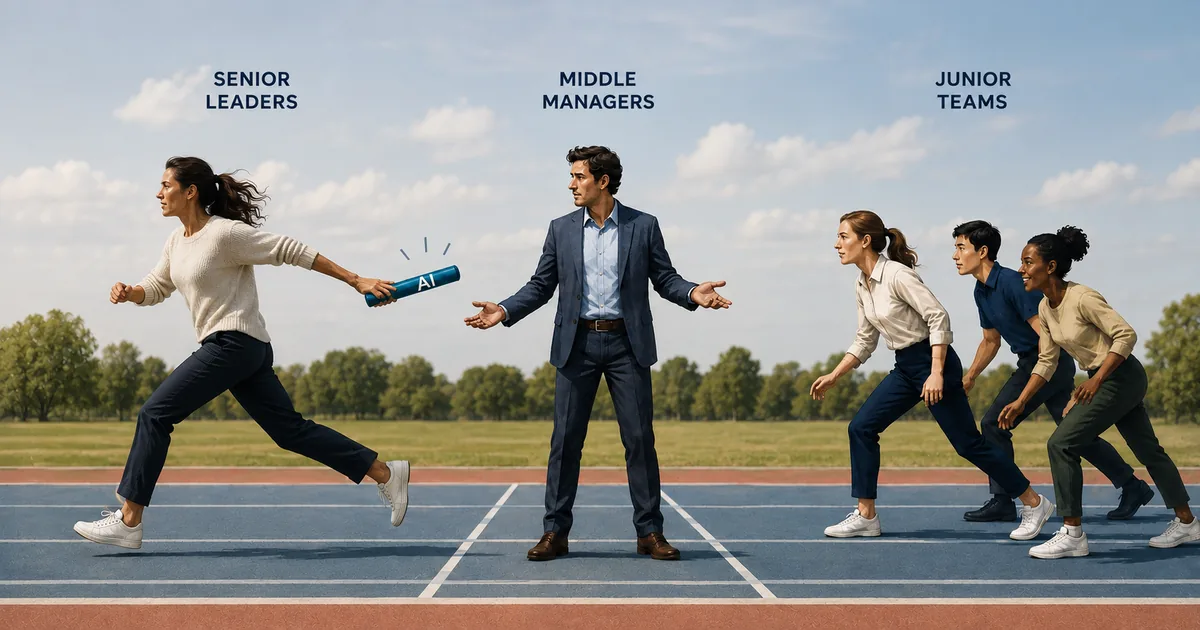
That person is not refusing. That person has been handed a relay job without the three things a relay needs: permission, clarity, and visible precedent.
Resistance and absence look identical on a dashboard
This is the practical problem. A usage report shows a manager at two logins a month. Resistance produces that number. So does having no idea whether the fortnight spent learning counts as work.
The two require opposite responses. If it is resistance, you make the case. If it is absent permission, making the case again is noise, and it lands as pressure on the person who already feels furthest behind.
We could tell them apart here because the same instrument asked about intention and value separately. Adoption intention across the workforce ran at 4.05, with 80 per cent agreeing. Perceived usefulness sat at 3.96, and Contribution was the strongest of the Five C’s at 3.81.
Nobody in that organisation needed convincing that AI is worth using. They had already bought it. So the persuasion budget was the one line of the programme guaranteed to return nothing.
The cheapest lever is the one nobody costs
The measure that moved most across the organisation had nothing to do with training or tooling. It was this one: “Most of my colleagues use AI tools as part of their day-to-day work.”
Among people who never use AI, it ran at 2.77. Among daily users, 4.14. It climbed in a clean line across every band in between.
Descriptive norms are a well-established antecedent of behaviour, which makes the more useful reading run from visibility to use rather than the other way round. People who cannot see colleagues using it do not use it. Our design is cross-sectional and cannot demonstrate that direction, so we hold it as the warrant for the intervention rather than as a finding in itself.
That reframes the manager problem entirely. A manager who uses AI quietly, at home, on a Sunday evening, to prepare something for Monday, contributes nothing to their team's norm. The private use of an enthusiastic manager and the non-use of a reluctant one produce the same visible signal, which is none at all.
The permission underneath the permission
One more number, because it is the one that changes what you do on Monday.
“If I make a mistake using AI on my team, it is not held against me” scored 3.32. More than half of respondents, 52 per cent, chose neither agree nor disagree.
In the same organisation, leader inclusiveness ran at 4.22. Managers are experienced as approachable, open to ideas, willing to listen. That is not the gap.
The gap is that practice has spread faster than the standing of a mistake. Half the workforce does not know what happens if AI gets something wrong in their hands. The cost of that is concealment rather than recklessness. Where people cannot tell whether an error will count against them, errors stop surfacing, and an organisation that cannot see its mistakes cannot find where AI is being used badly.
Now ask a manager to model AI use in front of their team. You are asking them to be visibly imperfect at something in public, inside an organisation where half the workforce has not been told what happens next. The thin take-up starts to look rational.
What we would actually do
Three moves, in this order, and none of them is a training purchase.
Make manager use visible, including the parts that go wrong. The evidence on leader modelling is strong, and the counter-intuitive part is that visible struggle outperforms visible competence. A manager who says “I tried this, it gave me something useless, here is what I changed” hands their team both permission and a method. A manager who only shares the polished output hands them a standard to fail against.
Settle the mistake question out loud. Not in a policy document nobody opens. In a sentence, from a named person, in a team meeting: this is what happens when AI gets it wrong here. Half the workforce is waiting for that sentence and does not know it.
Make the learning time legitimate and say so. Time and reward was the second-weakest reading in the manager layer at 3.18, behind only their view of whether leadership is consistently behind it. Learning time that is not named as work is time taken from something else, and managers are the layer with the least discretionary slack to take it from.
All three are cheaper than the programme most organisations buy instead.
The honest limits
This is one organisation, so we are not claiming the manager layer behaves this way everywhere.
We are claiming that if you have written “middle management resistance” on a slide, you have made a diagnosis that a short diagnostic could test, and the test is worth running before the budget is committed.
The frozen middle is real. It is mostly not made of what people think it is made of.
Where does your organisation actually sit?
PRISM answers with evidence rather than opinion.
Explore PRISM