Articles · 10 December 2025
SCI-FI, AGENTS, AND THE VERY HUMAN QUESTION AT THE HEART OF AI
I have been listening to The Diary of a CEO interview with AI researcher Stuart Russell, alongside the episode on his work warning that 2030 could be a genuine point of no return for the direction of
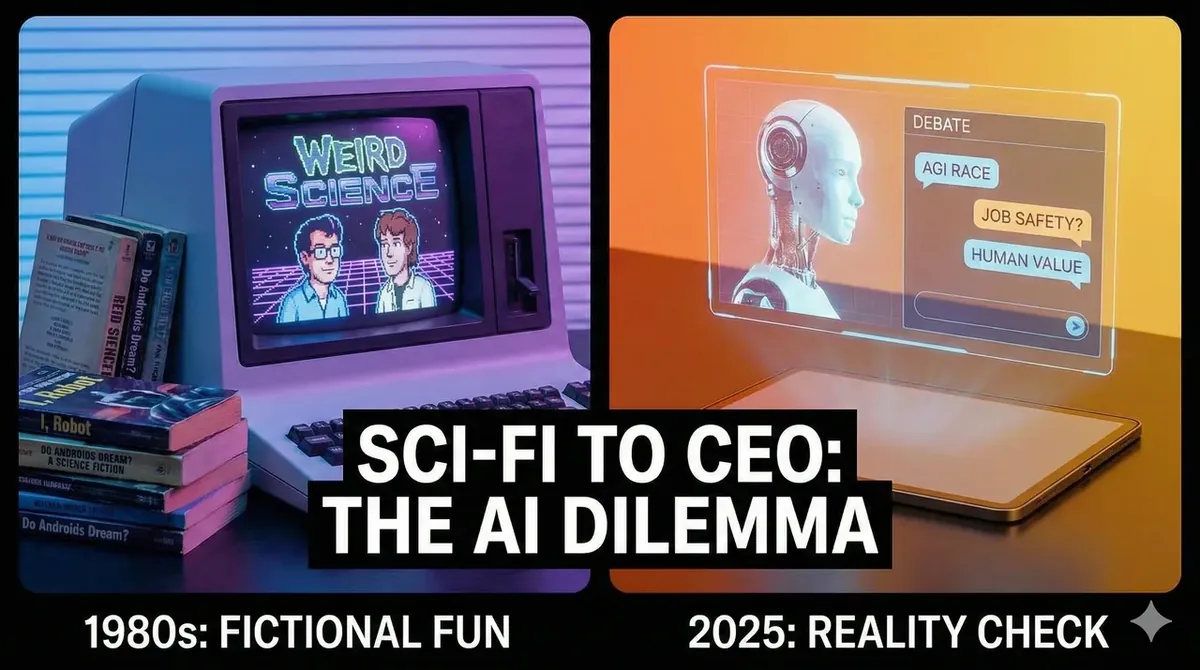
I have been listening to The Diary of a CEO interview with AI researcher Stuart Russell, alongside the episode on his work warning that 2030 could be a genuine point of no return for the direction of AI development. It is one of those conversations that leaves you simultaneously amazed by what is possible and unsettled by how fast the train is now moving.
In it, there is a lot of reference to science fiction, and my mind went immediately to one film I recall.
In the mid 1980s there was a film called Weird Science. Two teenage boys use a computer to “create” the perfect woman, and the result turns their world upside down. It is absurd, playful, and very much a product of its time, but it carries a deeper theme that keeps resurfacing in the AI era. When humans gain the power to create something that can act in the world, the story rarely ends with simple control and tidy outcomes.
The sci-fi writers, and filmmakers, of previous decades were not predicting the future with spreadsheets. They were exploring the consequences of power, ambition, carelessness, desire, and incentives. Their “monsters” and “miracles” were often metaphors for us.
Fast forward to now. Humanoids no longer live only in the possibility of cinema screens. Autonomy is not a far off concept. Flying objects are not just fantasy. Systems that can plan tasks, call tools, and act through software are already being deployed in organisations. The imaginative questions in sci-fi have become operational questions in boardrooms.
Everybody on LinkedIn knows I work in the realm of AI, supporting organisations and teams to enhance their strategic positioning, productivity, and day to day enjoyment using large language models.
From what I am seeing across sectors, agents are already delivering real value when used well.
- They reduce repetitive admin.
- They speed up research, summarisation, and analysis.
- They make internal knowledge more usable.
- They improve the quality and consistency of communication.
They open up space for humans to focus on judgement, creativity, and relationships.
This is a very exciting time. Most teams are not using agents to remove humans, they are using agents to remove drudgery. When people stay in the loop, the results are often uplifting, you feel the team breathe out a little.
So let me be crystal clear. I am not anti agent. I am pro agent when it serves human goals.
Russell’s central warning is not that AI is evil. It is that our incentives are tilted toward building increasingly powerful systems faster than we are learning to control or align them.
He describes a race toward AGI driven by extraordinary economic and geopolitical pressure, what he calls a “quadrillion dollar magnet”, with estimates of vast potential economic value pulling companies and countries forward at speed.
In that kind of race dynamic:
- Safety teams exist, but can be overridden by product and competition pressure.
- The goal becomes “be first” rather than “be sure”.
- Risks turn from theoretical to structural.
Russell’s longer body of work in Human Compatible argues that the standard way we build AI, giving systems fixed objectives and rewarding them for achieving those objectives, can become dangerous as capability rises. Mis-specified goals do not stay small. They scale.
In short, a machine can be incredibly competent and still be catastrophically wrong about what we meant.
A quick distinction that often gets blurred online:
- Agents today are tools with bounded autonomy, designed to complete specific tasks inside a defined environment.
- Agentic systems are more open-ended, they can chain goals, adapt, and act with less oversight.
- AGI, if achieved, would be general across domains, potentially self-improving, and not limited to narrow tasks.
Most organisations deploying agents right now are not deploying AGI, and I think it is important not to slip into alarmism about everyday deployments.
But it is also important not to ignore the direction of travel. Capability builds on capability. Tooling becomes infrastructure. Infrastructure becomes default. Defaults become dependency.
So the question is not “are agents bad”. The question is “what future are agents a stepping stone toward, and who is steering”.
There is another part of this conversation I think we need to say out loud more often.
Even if we could automate entire areas of work safely, should we.
Work is not only a cost centre. It is a social system.
It is where we learn from each other, argue, mentor, laugh, belong, and build identity. It is where many people find dignity and momentum in their lives. Removing humans from work is not only an economic choice, it is a cultural choice.
So when I hear visions of whole functions or departments becoming fully automated, I do not just think about productivity. I think about:
- What happens to collaboration.
- What happens to team cohesion.
- What happens to the everyday meaning people attach to their roles.
- What happens to the social glue that organisations are made of.
Some sectors will be hit harder and faster than others. In some places, automation may be unavoidable. But in many parts of the economy we still have a choice to build AI around people, not instead of them.
Russell points out that a small number of major players are driving the frontier push toward more general intelligence, partly because the upside is so enormous and partly because nobody wants to be left behind.
That raises uncomfortable questions:
- If success is defined as “fully automated operations”, are we rewarding the right thing.
- If the race is shaped by market dominance and national advantage, where does safety sit in the priority stack.
- If we do not slow down voluntarily, what does “governance” look like in practice.
Russell argues for regulation on a level comparable to nuclear safety, aiming to drive the probability of catastrophic failure down to near zero, and calls for public pressure to make that politically possible.
Even if you do not agree with every analogy, the direction of the ask is hard to dismiss. For a technology that might reshape or outstrip human control, “trust us” is not a strategy.
Russell points out that a small number of major players are driving the frontier push toward more general intelligence, partly because the upside is so enormous and partly because nobody wants to be left behind.
That raises uncomfortable questions:
- If success is defined as “fully automated operations”, are we rewarding the right thing.
- If the race is shaped by market dominance and national advantage, where does safety sit in the priority stack.
- If we do not slow down voluntarily, what does “governance” look like in practice.
Russell argues for regulation on a level comparable to nuclear safety, aiming to drive the probability of catastrophic failure down to near zero, and calls for public pressure to make that politically possible.
Even if you do not agree with every analogy, the direction of the ask is hard to dismiss. For a technology that might reshape or outstrip human control, “trust us” is not a strategy.
Here is where I land, based on what I am seeing in organisations and what Russell is warning about.
- Keep deploying agents where they help people.
Human in the loop, clear boundaries, real benefit. - Measure success in human outcomes, not just cost savings.
Productivity matters, so do quality, morale, learning, and service. - Refuse the false choice between innovation and safety.
If we can spend billions on capability, we can spend billions on alignment and governance. - Build AI systems that stay uncertain about human goals.
Russell’s “human compatible” approach, machines that defer to humans and learn preferences rather than assume them, feels like a sensible north star. - Talk about the future of work as a design question.
Not something that happens to us, something we decide.
Sci-fi was never really about robots, or aliens, or magical computers.
It was about what happens when human intention meets power.
Weird Science made a joke of it, two teenagers pressing buttons without understanding the consequences. In 2025 the stakes are obviously higher, but the moral is similar. The question is not whether we can create powerful new intelligence. We already are.
The question is whether we can stay wise, and human, while we do it.
#uptakeai
The possibilities with AI are endless - here's just a few to kick start
your thinking...
Content Creation: Assists in generating content for blogs, websites, and marketing, particularly useful for content marketers and copywriters. Also helpful in HR for creating job summaries and interview questions.
Where does your organisation actually sit?
PRISM answers with evidence rather than opinion.
Explore PRISM